The Biggest Lie in Corporate Life Is Company Culture

At some point in your career, you knew the right answer. You also knew saying it out loud wasn’t worth the risk. That moment, that calculation, is company culture.
Here’s what I’ve been thinking about this week.
Every company actually has two cultures.
The first is the one you can find on the website. It lives inside leadership principles, values statements, onboarding decks, annual reports, and carefully designed presentations. It talks about transparency, ownership, innovation, collaboration, and growth. It is polished because it has to be. It exists to communicate what the organization wants to stand for.
The second culture is the one nobody writes down.
It lives in meetings, performance reviews, Slack messages, difficult conversations, and the countless small interactions that happen every day. It determines whether people feel comfortable speaking up, asking questions, admitting mistakes, or challenging an idea. And more often than not, this unwritten culture has a far greater impact on employees than anything displayed on office walls or company websites.
The real culture lives at the team level
Over the years, I’ve worked across multiple organizations and teams. One thing I’ve noticed repeatedly is that people place too much importance on company culture and not enough on what I call micro-culture: the culture created by your manager and the team around you. While companies spend enormous amounts of time crafting values and employer brands, employees experience work through a much smaller lens. They experience it through the people they interact with every day.
This is why culture is such a complicated topic. Ask ten people from the same company about its culture and you may get ten completely different answers. One person may describe it as empowering and collaborative. Another may describe it as political and exhausting. Both can be right. Because culture is not experienced at the company level. It is experienced at the team level.
You can join a company that consistently ranks among the best places to work. It can have incredible benefits, inspiring leadership messages, and beautifully articulated values. But if your immediate manager creates an environment of fear, insecurity, blame, or politics, none of that matters. It does not protect your mental space. It does not keep you motivated. It does not help you grow. The culture you experience every day will always be stronger than the culture the company advertises.
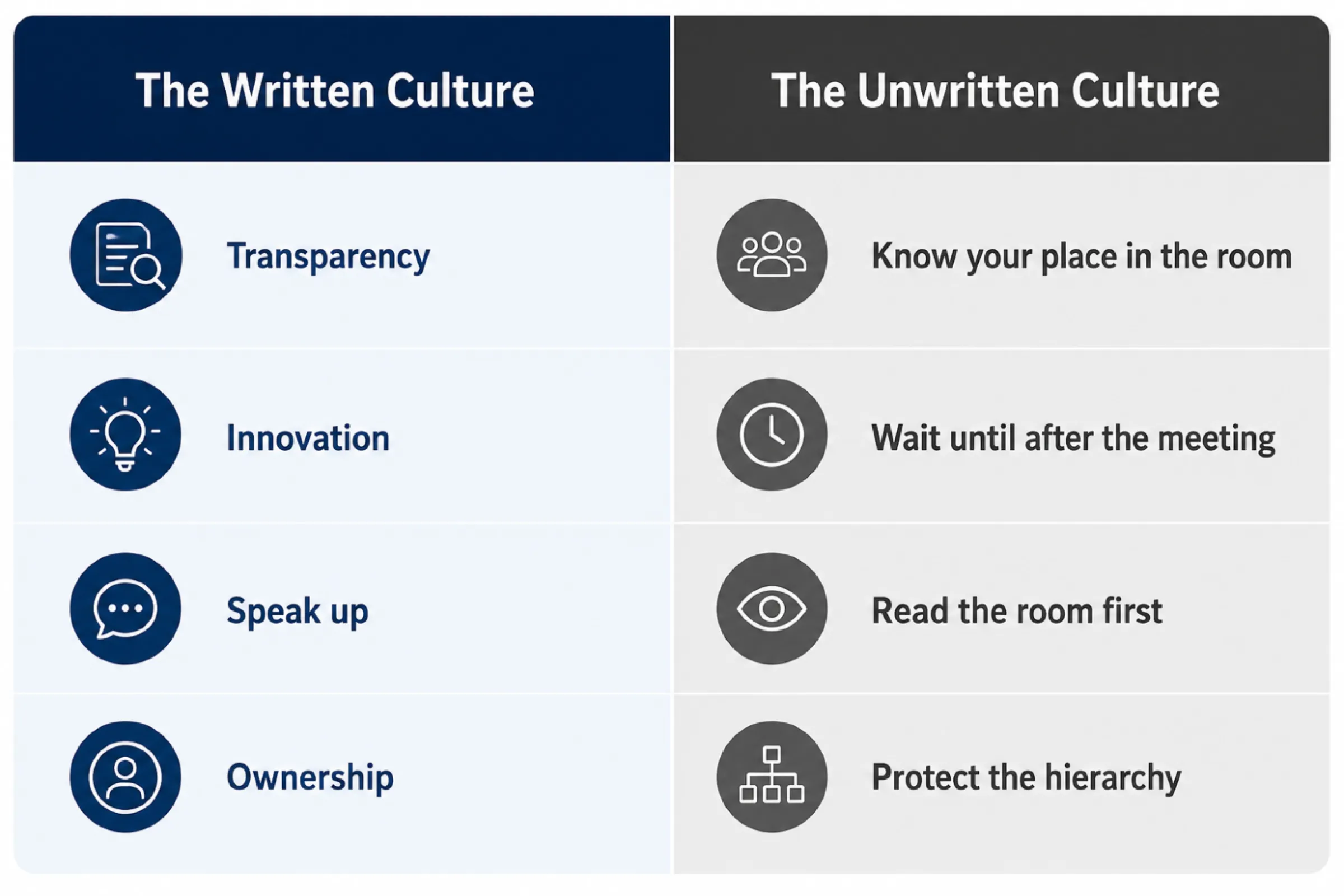
Know your place in the room
In many Indian organizations, I’ve observed a particularly powerful unwritten rule that tends to override everything else: know your place in the room.
Nobody explicitly teaches this rule. It rarely appears in policies or leadership training. Yet somehow everyone learns it. Employees become cautious about how they disagree. Questions become softer. Feedback gets filtered. Problems are discussed privately rather than publicly. Meetings slowly stop becoming places where the best ideas win and start becoming places where hierarchy is protected.
The engineer who spots a flaw decides not to push harder. The analyst who notices numbers that don’t make sense chooses not to challenge them publicly. The manager with a better idea waits until after the meeting to share it. Everyone tells themselves the same thing: this is not worth the fight.
A few moments from my own career
I started my career at Philips. When you’re young, fresh out of college, and fearless, you have this incredible zeal to change the world. I still remember when my director held a town hall and asked everyone to identify gaps in our current processes. I shared a long list of challenges without holding back. I spoke my heart out in front of a hall full of leaders, convinced it would be my last day at work.
At Mars, I challenged the traditional view of procurement. I believed marketing procurement should be measured by the quality of business outcomes, not by choosing the cheapest vendor.
At Landmark, I implemented a strategic sourcing framework and auction strategy. While Finance often pushed for awarding business to the lowest bidder, I consistently advocated for selecting the best vendor for creative and media services, even if they weren’t the lowest-priced option.
I don’t say this to suggest I always got it right. I say it because I think those early moments of discomfort are why I still can’t stay quiet when something feels wrong.
The hidden cost
That is where organizations begin paying hidden costs.
Most companies do not suffer because they lack intelligence. They suffer because intelligence stops moving upward. The problem is rarely that employees don’t know what is wrong. The problem is that employees don’t feel safe enough to say it. Once information starts getting filtered, leadership begins making decisions based on an edited version of reality. And when leaders lose access to reality, performance inevitably suffers.
This is why I believe culture should not be judged by what leaders say. It should be judged by what employees feel safe doing.
- Can someone disagree with their manager without damaging their career?
- Can a junior employee challenge an idea without being labeled difficult?
- Can mistakes be admitted without triggering blame?
- Can uncomfortable truths be spoken openly when they need to be?
The answers to those questions reveal more about culture than any mission statement ever could.
Before you ask “does this company have a good culture,” ask this instead
Over time, I’ve become increasingly skeptical of people who choose jobs primarily because of a company’s culture. Whenever someone tells me a company has a great culture, my first question is always the same: according to whom?
The CEO’s culture is not necessarily your culture. The company’s culture is not necessarily your team’s culture. The values written in a handbook are not necessarily the values practiced by your manager.
Because eventually every workplace encounters pressure. Deadlines get missed. Projects fail. Targets become harder. Budgets get cut. The real culture of a team reveals itself during those moments. Not during onboarding sessions. Not during town halls. Not during leadership speeches. During the difficult days, when things are messy and uncertain.
That is when you discover whether the people around you are invested in your growth or merely invested in protecting themselves.
Culture is people
Perhaps that is why culture remains so difficult to define. Culture is not a framework. It is not a document. It is not a slogan.
Culture is people. And the people closest to you matter the most.
So the next time you evaluate a career opportunity, pay less attention to what the company says about itself and more attention to who you will report to. Your company may have one culture on paper, but your career will ultimately be shaped by the micro-culture you live inside every single day.
That’s it for this edition of What Nobody Talks About. If this resonated, forward it to someone who’s navigating the same thing right now.
See you in the next one,
Raj.